PPC
4 June 202611 min readMatthew HobsonGoogle Marketing Live 2026: What It Means for Ecommerce Brands
Google Marketing Live 2026 put Gemini at the centre of search, shopping and measurement. Our take on AI Max for Shopping, Universal Cart, Asset Studio and Meridian in Analytics 360, and what ecommerce brands should actually do about each.
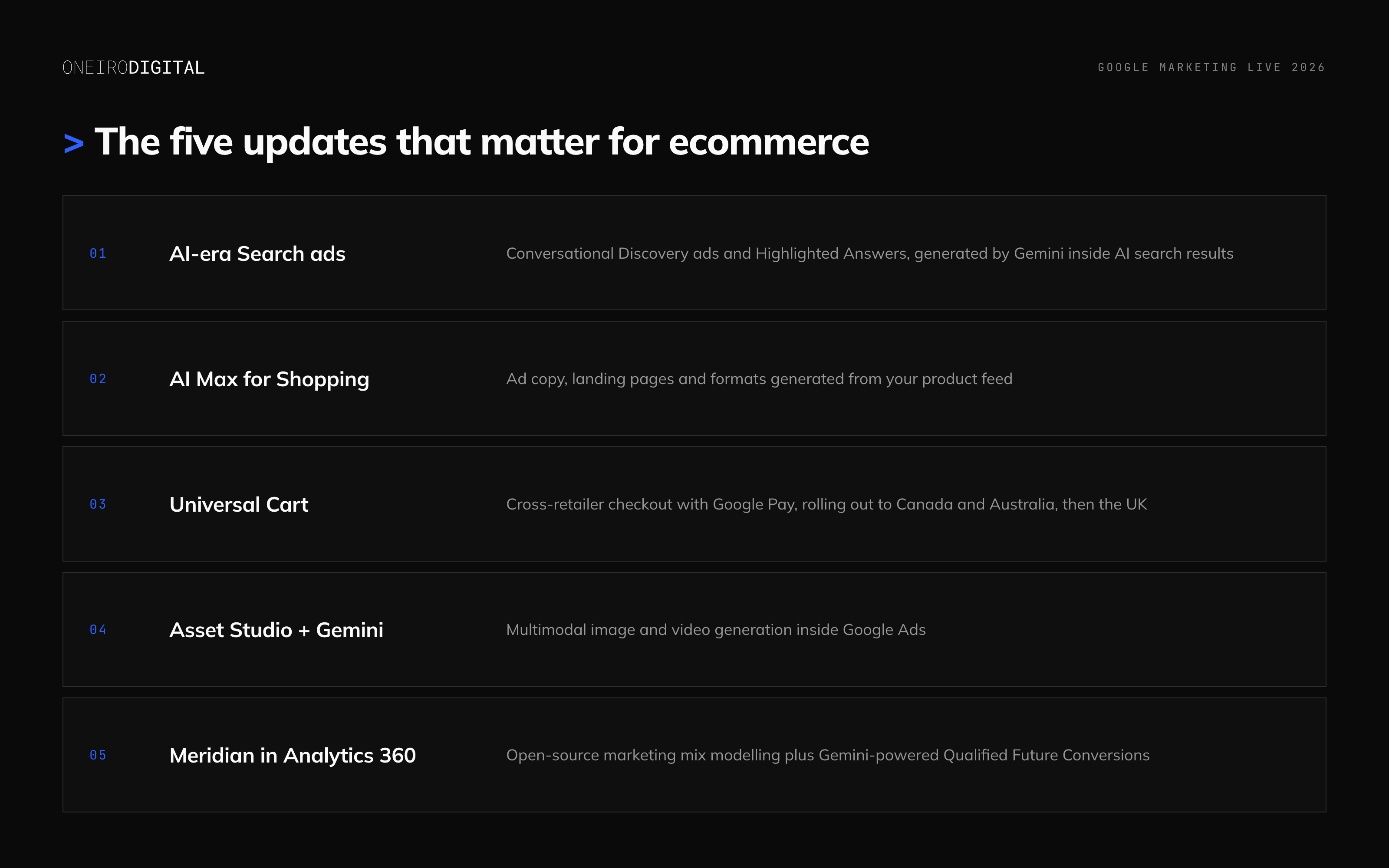
Google Marketing Live 2026 landed this week, and the keynote message was not subtle. In Google's own words, the only way to win in the age of AI is with AI. Strip away the staging and the announcements follow a single pattern: decisions that used to belong to your marketing team are moving into Gemini, and what you keep control of is the data you feed it. We have read the full announcement collection and the product deep dives behind it. Here is what actually matters if you run an ecommerce brand, and our honest view on each change.
The pattern behind the announcements
Look across everything announced and the same trade is being offered each time. Google's models take over a lever you used to pull manually: which queries you appear for, what the ad says, which page it lands on, what the creative looks like, and increasingly where the purchase itself completes. In return you are promised performance. What Google cannot generate for you is the raw material: your product data, your margins, your first-party signals, and the accuracy of the conversion data its bidding learns from. That is the part you still own, and in our view it is now the only durable advantage left in paid media. Teams that treat feed quality and measurement as an afterthought will be handing a very powerful machine very poor instructions.
AI-era Search ads: ads become answers
Google is testing two new ad formats built with Gemini. Conversational Discovery ads respond to a shopper's specific question rather than just their keywords, and Highlighted Answers surface products inside AI-generated recommendation lists. The Direct Offers pilot is also expanding, including native checkout that lets someone buy from the results page without ever reaching your site.
AI Max for Shopping: the feed is the campaign
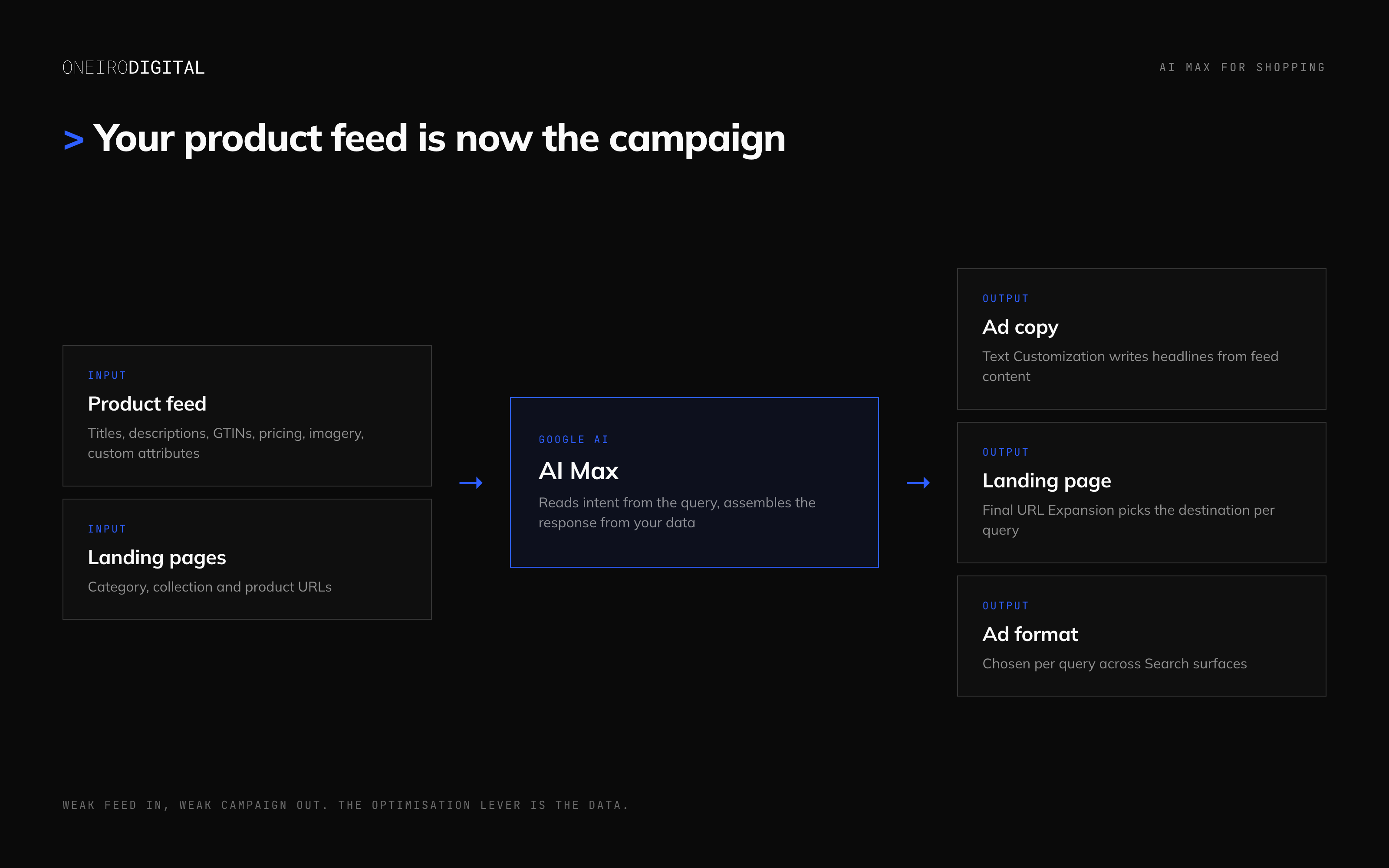
AI Max is expanding to Shopping campaigns. Text Customization generates ad copy from your feed content, Final URL Expansion chooses the landing page it believes best matches each query, and the format itself is assembled per query across Google's search surfaces. The campaign you used to build by hand is now generated from your product data at auction time.
Universal Cart and agentic commerce
The Universal Commerce Protocol announcements are the furthest reaching. Universal Cart is a cross-retailer basket that works across Search and Gemini, with checkout through Google Pay, and Nike, Sephora, Target, Ulta Beauty, Walmart, Wayfair, Fenty and Steve Madden already named as participating brands. Shopping ads on YouTube are gaining instant purchase, with buy now pay later through Affirm and Klarna. The rollout goes to Canada and Australia in the coming months, followed by the UK. Merchant Center is also gaining an AI performance insights tool that benchmarks your share of voice on AI surfaces against similar brands.
Asset Studio: creative at machine speed
Asset Studio is gaining multimodal Gemini capabilities that generate image and video assets inside Google Ads, working from your brand guidelines and refining output through plain-language prompts. Creative production volume effectively stops being a constraint.
Meridian moves into Analytics 360
Google is bringing Meridian, its open-source marketing mix model, into Analytics 360 to act as a measurement command centre, with the stated aim of proving causal performance rather than reporting clicks. Alongside it, Qualified Future Conversions use Gemini-powered signals such as brand search behaviour to link upper-funnel spend to sales that have not happened yet.
What to do now
| Action | Why it matters now |
|---|---|
| Audit your product feed: titles, GTINs, attributes, imagery | AI Max and the new search formats assemble your ads directly from it |
| Fix conversion tracking before granting more autonomy | Google's bidding learns from the data you send; bad data scales badly |
| Strengthen first-party data capture | Universal Cart moves checkout, and the relationship, towards Google |
| Prepare measurement for off-site conversions | Sales will complete on Google surfaces; attribution needs to follow them |
| Set brand guardrails for generated copy and creative | Text Customization and Asset Studio will be speaking for your brand |
| Re-baseline search reporting for AI formats | Impression and CTR patterns will shift through 2026 either way |
UK brands have something US brands do not: time. Most of what was announced is US-first, with the UK explicitly later in the rollout. That window is worth something only if it is spent on the unglamorous work, feeds, tracking, first-party data, that every one of these announcements quietly depends on. It is not a coincidence that every product Google launched this week rewards the same thing. Clean data is where the leverage is, and Google has just told everyone so.
More insights
← All articlesWork with us
Start a project